Live AI voice panel: several AI voices, one live call
Updated: October 5, 2026
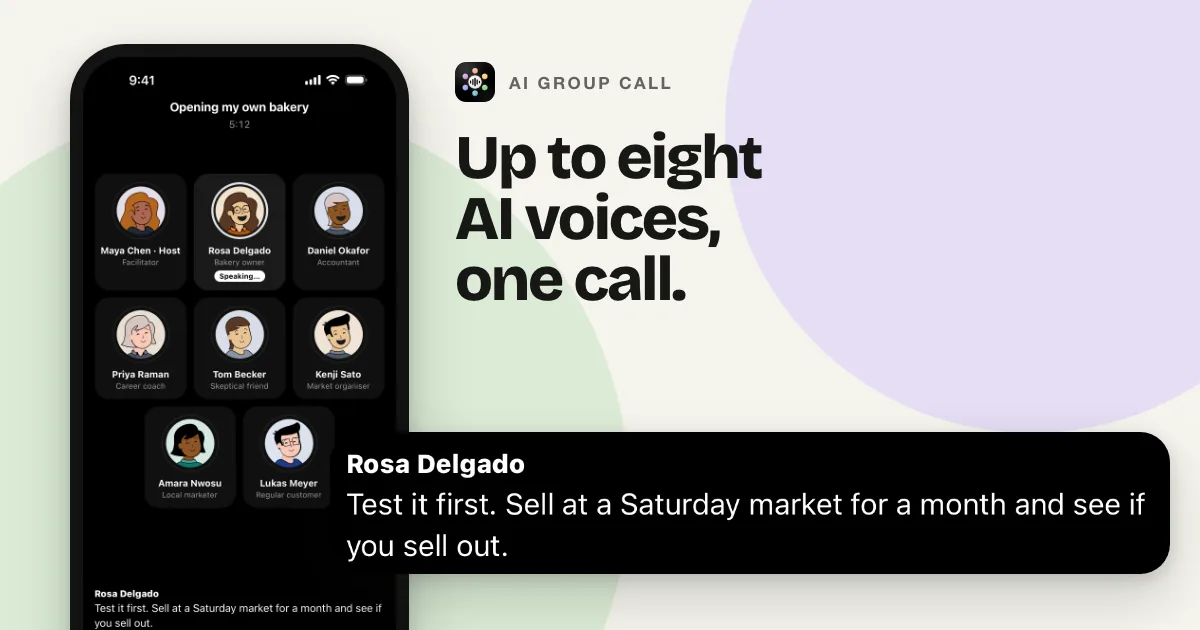
Search "group call" and you get school communication apps and conferencing software, because those are the products that have claimed the words. This page is about a different thing that has started to exist: a live AI voice panel. Not a tool for reaching a group of people, and not a meeting room with an AI note-taker bolted on. It is a call where the other people on the line are AI, and they talk to each other about your question, out loud, while you listen, jump in, and steer.
What a live AI voice panel is
Pick a category for each tool on the list below and the differences stop being features. The first two rows are what most "group call" products are: ways to reach a group of humans. A live AI voice panel is the third row, and AI Group Call is built as one:
| School communication tool | Video conferencing app | Live AI voice panel | |
|---|---|---|---|
| Who is on the call | Real parents, students, staff | Real colleagues or clients | You and two to eight AI participants |
| What it is for | Announcements, attendance, messaging families | Hosting a meeting between people | Working through one goal with a room that is always available |
| Who does the thinking | Nobody; it carries messages | Nobody; it carries the meeting | The room does: a host, role players, and a skeptic argue it out |
| Cost of the room | Per-teacher or per-school plans | Per-host licenses, minutes of everyone's calendars | Your minutes only; the room size does not change the price |
| What you keep | The sent message | A recording nobody re-watches | A transcript, a summary, and action items |
The mechanics are what make the category feel like a call rather than a chat window. You type a goal, and the app writes a cast around it: a host who keeps the round moving, participants with different roles, and in rooms of four or more at least one skeptic. Everyone hears the whole conversation before their turn, so the room builds instead of each seat answering you separately. Speak and the current speaker stops; name a participant and they answer you. Type in Chat when a number is easier to spell than to say, and on a paid plan share up to three screenshots or photos per message for the room to react to.
What it sounds like
A solo founder puts a pricing question to a five-seat panel.
Example call, written for this page
You Should my writing app charge nine dollars a month or go usage-based?
Amara, host Let's take positions. Theo, product: which model fits how people actually use it?
Theo, product Nine flat. Usage pricing on a tool people open for ten minutes on a Sunday makes them ration the thing that's supposed to be a habit.
Priya, finance Flat works if the heavy ten percent don't eat the margin. What's your distribution of usage today?
You Top decile is ninety percent of my compute.
Sam, skeptic Then nine flat is a subsidy from the light users to the heavy ones, and the heavy ones are the ones who leave when you raise it.
Amara, host So the real question is the cap, not the price. What if it's nine flat with a generous cap, and a metered tier above it?
That is one conversation, spoken aloud, with the disagreement left in. When you hang up, the call is saved in History with its full transcript; one tap turns it into a summary with key points and action items, and Join again brings the same cast back with the earlier conversation in front of them.
Why the category needs a name
Because the unnamed version gets mistaken for the first two rows. People download expecting a conferencing app and never find the mic; app stores sort the product under the wrong heading; and the person who wants exactly this has no words to search for it. So, precisely:
- It is not a group chat. A group chat is typed and asynchronous, whether the members are people or AI characters. This is a real-time call: voices, turns, interruptions.
- It is not a video conference with AI. There is no camera, no scheduling link, no other humans to wait for. The AI participants are the room.
- It is not one AI assistant. The point is that the viewpoints stay separate and audible: host, specialists, skeptic, each with a seat, rather than one blended answer.
- It is not a voice memo to a bot. The panelists hear each other. Ask the skeptic to respond to the optimist and they do, unprompted by a prompt.
You can even fill the seats with named AI models instead of personas: on the Models tab, pick Claude, GPT, Gemini, Grok, Qwen, DeepSeek and others, one model per seat, and hear them talk your question through. That version of the panel is covered on the LLM Council page. Calls run in 15 languages, and the cast is written in the language you pick or the language you type your goal in.
Questions
Is a live AI voice panel a video call?
No. Nothing on the call is video: the participants are AI, so there are no cameras, no waiting rooms, and no links to send. It is a live voice conversation with a caption under each speaker, on your phone, in the app.
Are the AI participants talking to each other or just to me?
To each other as well as to you. Every participant gets the whole conversation so far before its turn, so one voice picks up or pushes back on another's. A director picks who speaks next in the general back and forth, and the participant you name goes first.
How long is a call, and what does it cost?
A single call runs up to 30 minutes; pausing stops the clock. New accounts get three minutes of call time in total, with no card required. Monthly plans add 30, 60, 90 or 120 minutes, and the price does not change with room size: two to eight participants all cost one minute per minute.
How is this different from asking one AI assistant?
One assistant blends everything into a single careful answer. A panel keeps the viewpoints separate and audible, including the objection the average would smooth over, and you referee: ask either side to defend itself, or take the floor yourself mid-sentence.
Try it
Three minutes free per new account, no card required. Get it on Google Play or download it on the App Store. For the underlying idea in plain words, read Talk to multiple AIs at once, and for the text-chat comparison, AI group chat: live voice call vs text group chats.