Karpathy's LLM Council idea, as a live voice call
Updated: September 27, 2026
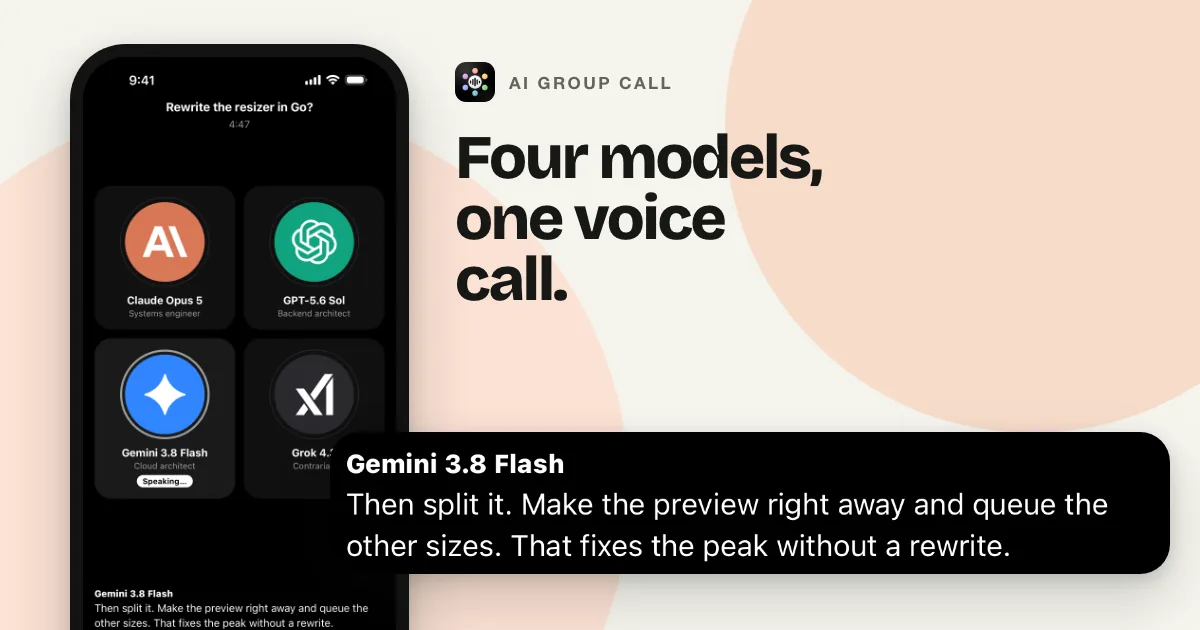
In late 2025 Andrej Karpathy published LLM Council, a small open-source web app that sends one question to several language models, has them review each other's answers, and asks a chair model to write the final reply. AI Group Call takes the same instinct, that several models together beat one model alone, and turns it into a live voice call on your phone. You pick the models for the seats, and they talk it through with you out loud.
What LLM Council is
Karpathy's llm-council is a local web app he described as a weekend project. It works in three stages. First, your question goes to every model on the council and each writes its own answer. Second, each model is shown the other answers with the names hidden and asked to review and rank them. Third, a chair model reads everything and writes one final response. The appeal is simple: you see where the models agree, where they differ, and which answers the other models rate highly.
AI Group Call is not affiliated with Karpathy or that project. It is a separate app built on a similar observation.
What changes when the council talks out loud
| LLM Council (web app) | AI Group Call | |
|---|---|---|
| Format | Text answers side by side | A live voice call |
| How models react to each other | Anonymous review and ranking in stage two | Each model hears the whole conversation before its turn and replies to what was just said |
| Final word | A chair model writes one answer | A summary with key points and action items once the call ends |
| Your part | Ask, then read | Ask, listen, interrupt, follow up, type or share images |
| Where it runs | Your own computer, with your own API keys | An iPhone or Android app with minutes included in a plan |
The biggest difference is time. In a written council each model answers once. On a call the second and third rounds are where things get interesting: one model changes its position after hearing another, or two of them dig in on opposite sides and you get to ask each why.
Picking the seats
Before a call, open the Models tab and choose which models sit in the room. The list covers the major labs, including Claude, GPT, Gemini, Grok, Qwen and DeepSeek, with a short note on each. One model goes in each seat, from two up to eight seats. Each seat's replies are written by that model and spoken aloud. The rest of the call works as usual: one speaker at a time, everyone hears everything, and you take the floor back by talking.
A few mixes worth trying:
- One model from each lab. The most direct version of the council idea, and the easiest way to hear house styles side by side.
- A small pair. Two models with a reputation for disagreeing, for a fast back and forth on one decision.
- Big and small from the same lab. Useful when you want to know if the larger model is worth it for your kind of question.
If you would rather have roles than model names, skip the Models tab and use the standard cast, which is written around your goal with a host, a skeptic and other viewpoints.
A worked example
A developer asks a four-seat council whether to rewrite a slow Python service in Go.
Example call, written for this page
You Our image-resizing service is Python and it falls over at peak. One of the team wants to rewrite it in Go. Is that the right call?
Claude Before a rewrite, I would want to know where the time goes. If it is the resizing itself, the heavy lifting is probably already in C underneath Python, and Go will not buy you much.
GPT I agree on measuring first, but I would push back a little. If the problem is concurrency, a Go service with a worker pool is simpler to reason about than tuning Python processes.
Grok Or neither. Put a queue in front of it and let peaks wait thirty seconds. Does anyone need the resized image instantly?
You Uploads show a preview right away, so yes, the first size matters. The others could wait.
Gemini Then split it. Generate the preview synchronously, push the other sizes to a queue. That fixes the peak without a rewrite, and you can still port the preview path later if it stays slow.
GPT That is a better first step than what I suggested. Rewrite only if the preview path alone is still too slow.
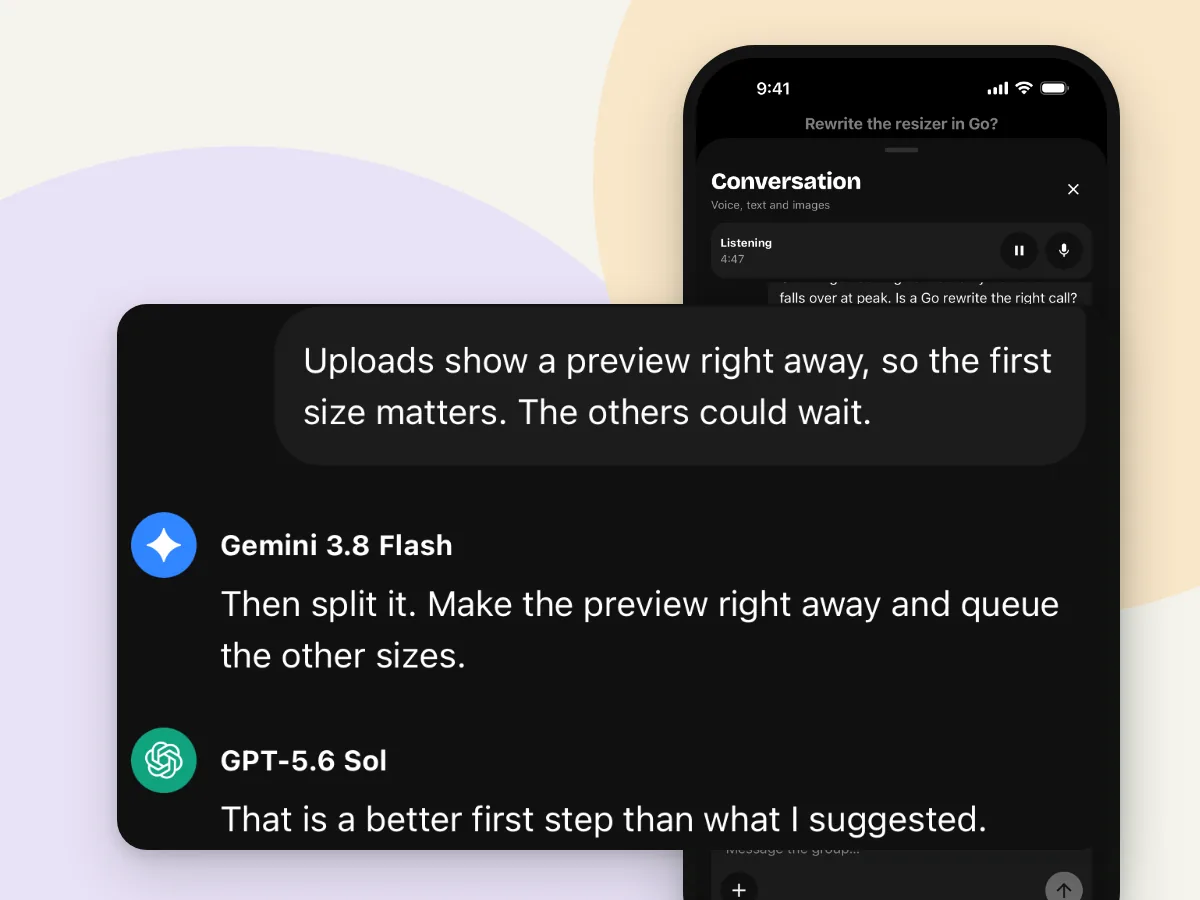
Four models, four starting positions, and by the end a plan most of the room agrees on, including one model walking back its own suggestion after hearing a better one.
Getting a useful council
- Ask each model to commit first. "Each of you give a one-line answer, then we argue" stops the room drifting toward a polite consensus.
- Invite disagreement by name. "Grok, what is wrong with Gemini's plan?" gets a direct critique.
- Send the detail in text. Paste an error message or a config into Chat. On a paid plan you can share up to three screenshots per message.
- Keep the transcript. The saved call shows who said what, which makes it easy to see which model gave the answer you ended up using.
Honest limits
Spoken turns are short, and the models in the seats are set up to start answering quickly rather than think for a long time first. That makes a call good for debate, trade-offs and follow-up questions, and less suited to long proofs or big blocks of code. It is also not a benchmark: a model that sounds confident on a call is not necessarily right. For a careful written comparison, a text tool like the original LLM Council is the better fit.
Questions
Is AI Group Call made by Andrej Karpathy?
No. LLM Council is Karpathy's open-source project. AI Group Call is a separate app from Neu Software LLC that applies a similar idea to live voice calls.
Which models can sit on the council?
The Models tab lists models from the major labs, including Claude, GPT, Gemini, Grok, Qwen and DeepSeek. The list is updated on the server, so new models can appear without an app update.
Do the models hear each other?
Yes. Before each turn, the speaking model is given the whole conversation so far, including what the other models and you said.
Try it
Three minutes free per new account, no card required. Get it on Google Play or download it on the App Store. For more on how a call with several AI participants works, read Talk to multiple AIs at once.