Practice your pitch with AI investors, out loud
Updated: September 27, 2026
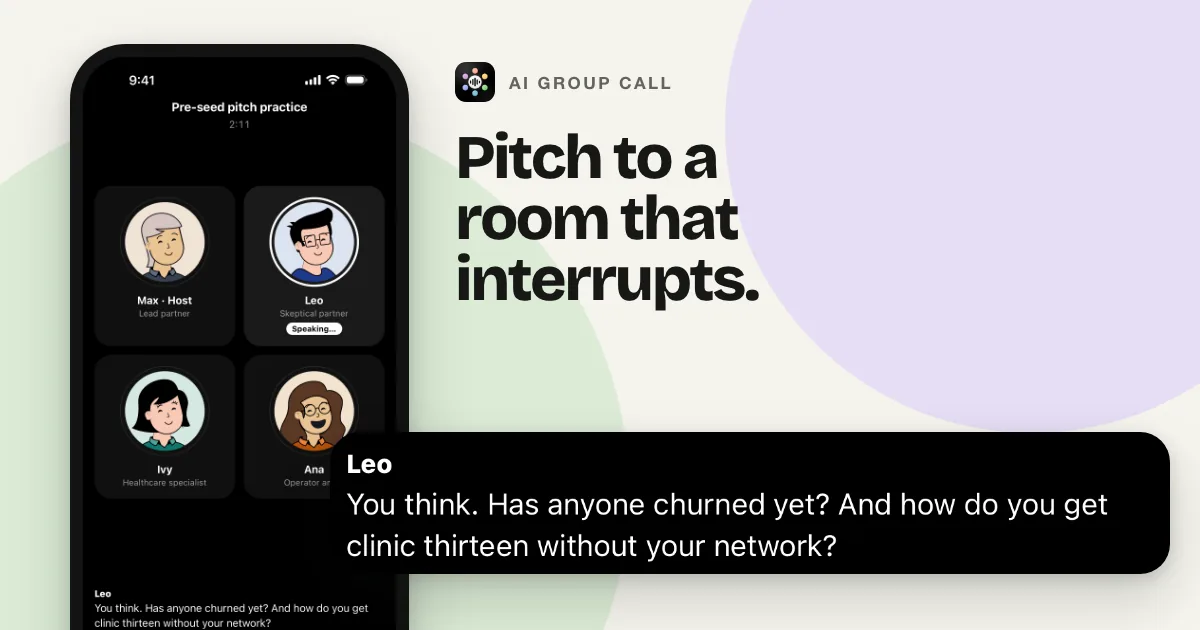
Most pitch practice happens alone, reading slides to a wall, or with one friend who is too kind. The real meeting is different: several people, each listening for something else, cutting in with questions before you reach the slide that answers them. AI Group Call lets you rehearse against that. You pitch out loud on a live voice call, and a room of AI investors interrupts, follows up on each other's questions and argues about whether they would invest.
Why practise with a group, out loud
A pitch rarely fails on the deck. It fails in the questions: the market size you cannot defend, the competitor you did not mention, the pause when someone asks why now. Those moments are hard to practise in a text chat, because typing an answer gives you time a real meeting does not. Out loud, with interruptions, you find out which answers you actually know.
A group also asks different kinds of questions. A lead partner wants the story and the team. A skeptical partner wants the reason it fails. A market specialist wants to know who else is doing this. Hearing them build on each other is closer to a partner meeting than any single interviewer can be.
Setting up the room
Type a goal that describes the raise and the room you want. The app writes a cast around it, with a host who runs the meeting and, in rooms of four or more, at least one skeptic. For example:
- "Practice my pre-seed pitch. I'm raising $750k for a scheduling tool for dental clinics. Act as a partner meeting: a lead partner running it, a skeptical partner, a healthcare market specialist and an angel who was an operator. Interrupt me."
- "Mock demo day Q&A. Three investors, tough questions only, after a two-minute pitch."
Three to five investors keeps the pressure realistic. You can edit any participant's name, role or personality during the call, so if you want a particular type of investor, change one seat and carry on.
Slides: on any paid plan, share up to three screenshots or photos per message in Chat, and the room discusses what it sees. Share the slides that carry the argument (problem, traction, the ask) rather than all twenty.
A worked example
An excerpt from the dental scheduling pitch, two minutes in.
Example call, written for this page
You We have twelve clinics paying us, all found through my own network, and the average clinic cuts no-shows noticeably in the first month.
Max, lead partner Twelve is a good start. How many of those would still be customers if you were not the one who sold them?
You I think most of them. The product does the work.
Leo, skeptic You think. Has anyone churned yet? And how are you getting clinic thirteen through a hundred without your network?
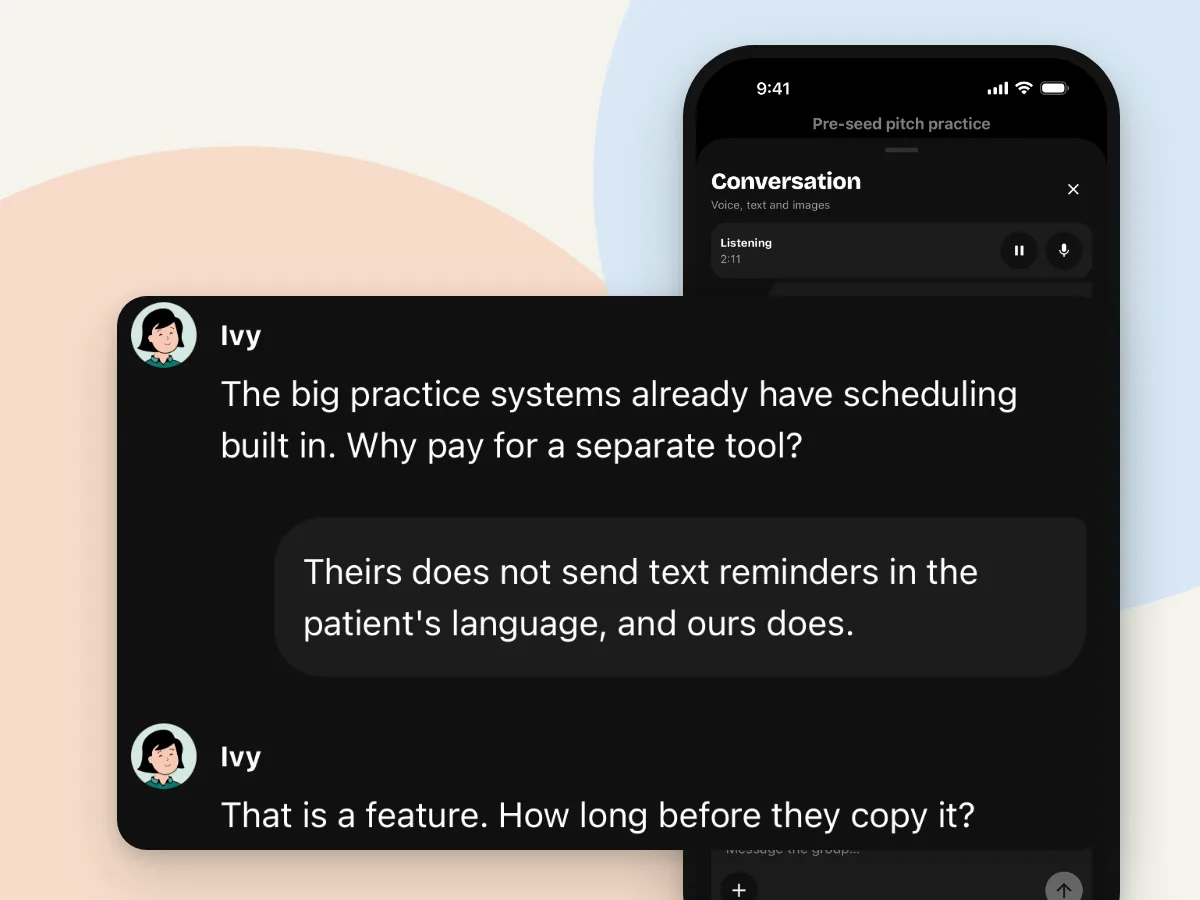
Ivy, market specialist And the big practice-management systems already have scheduling built in. Why does a clinic pay for a separate tool?
You Because theirs does not send reminders by text in the patient's language, and ours does.
Ivy, market specialist That is a feature. How long before they copy it?
Max, lead partner Let's pause on the ask. You are raising seven fifty. What does that buy in months, and what number do you need to hit to raise again?
By the end of a round like this you have a list of the questions that hurt: churn, distribution beyond your network, and defensibility against incumbents. Those are the ones to fix before a real meeting.
Drills worth running
- The short version. Ask the room to stop you after one minute and tell you what they remember. If it is not the thing you wanted them to remember, rewrite the opening.
- Hostile Q&A. Skip the pitch, give a one-line summary, and ask for ten minutes of the hardest questions they can find.
- The numbers round. Ask the room to question only your figures: market size, pricing, burn, what the round pays for.
- The same pitch, a week later. Open the call in History and tap Join again. The same investors come back with the earlier conversation in front of them, so you can ask whether your answers improved.
- Another language. Calls run in 15 languages, useful if you are pitching investors abroad.
Using the transcript
Every call is saved in History. Tap once for a summary with key points and action items, or read the full transcript and mark every question where you hesitated. Write a better answer to each, then run the drill again. You can share the summary and transcript from the app, which is handy for a co-founder who needs to know what investors are likely to ask them.
What it cannot tell you
The investors are AI voices, not real funds. They cannot tell you whether you will raise, and they do not know what a specific fund is investing in this quarter. If a participant quotes a market figure, check it before it goes in your deck. What the room is good at is making you say your answers out loud, under interruption, until they come out clean.
Questions
Can the AI investors see my pitch deck?
On any paid plan you can share up to three screenshots or photos per message in Chat, and the participants discuss what they see. The free trial includes voice and typed messages.
How long can a practice session be?
A single call runs up to 30 minutes, and pausing stops the clock. New accounts get three minutes of call time free, once. After that, monthly plans are $4.99 for 30 minutes, $9.99 for 60, $13.99 for 90 and $17.99 for 120. One minute with the whole room uses one minute, however many voices are in it.
Can I practise with the same investors again?
Yes. Tap Join again on a saved call and the same cast returns with the earlier conversation in front of them.
Try it
Three minutes free per new account, no card required. Get it on Google Play or download it on the App Store. To test the idea itself before you pitch it, try Roast my business idea.