AI panel interview practice, by voice
Updated: September 27, 2026
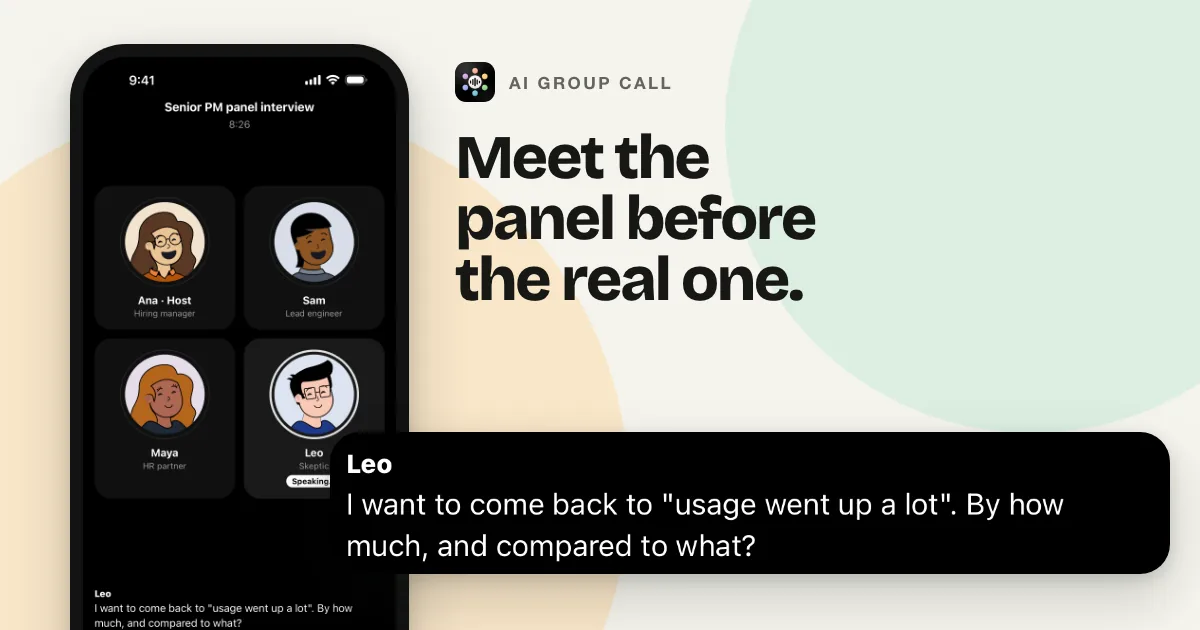
A one-to-one interview is a conversation. A panel interview is several conversations at once: one person asks, another follows up on your answer, a third writes something down and comes back to it ten minutes later. AI Group Call lets you practise that out loud. You join a live voice call with a panel of AI interviewers, each with a different job, and answer them in real time.
Why panels are harder
Most interview practice tools are one interviewer and one question at a time. That trains you to answer questions, but a panel tests something else: whether you can hold a thread while someone else pulls on it. The hiring manager asks about a project, the peer asks how you handled the technical side, and the HR partner asks what you would do differently. Each follow-up builds on the last answer, and a weak answer early on gets picked up again later.
On an AI Group Call panel, every interviewer is given the whole conversation before their turn. That is what makes the follow-ups realistic: the peer can ask about something you told the hiring manager, and the skeptic can point out that your two answers do not quite match.
Setting up the panel
Type a goal with the role, the company type and the panel you expect. The app writes a cast around it, with a host who keeps the interview moving. For example:
- "Panel interview practice for a senior product manager role at a fintech startup. Panel: the hiring manager, a lead engineer, a designer and an HR partner. Behavioural and product sense questions. Push on vague answers."
- "Nursing job interview with a panel of three: ward manager, senior nurse, HR. Ask about patient safety and teamwork."
Three to five interviewers is realistic for most panels. If you know who will be in the room, describe them. You can also edit a participant's name, role or personality during the call, for example to swap a friendly interviewer for a tougher one.
A worked example
An excerpt from the product manager panel above.
Example call, written for this page
Ana, hiring manager Tell us about a product decision you made that turned out to be wrong.
You We launched a savings feature that assumed users would set a monthly goal. Almost nobody did. We changed it to round-up savings and usage went up a lot.
Sam, lead engineer What did the first version cost the team, and how did you decide to kill it rather than iterate?
You About six weeks of work. We gave it a month, looked at the numbers, and decided the goal step was the problem.
Maya, HR partner How did the engineers who built it take that?
Leo, skeptic I want to come back to “usage went up a lot”. By how much, and compared to what? If I were hiring you, I would want the number.
Ana, hiring manager Fair point. Can you give us the before and after?
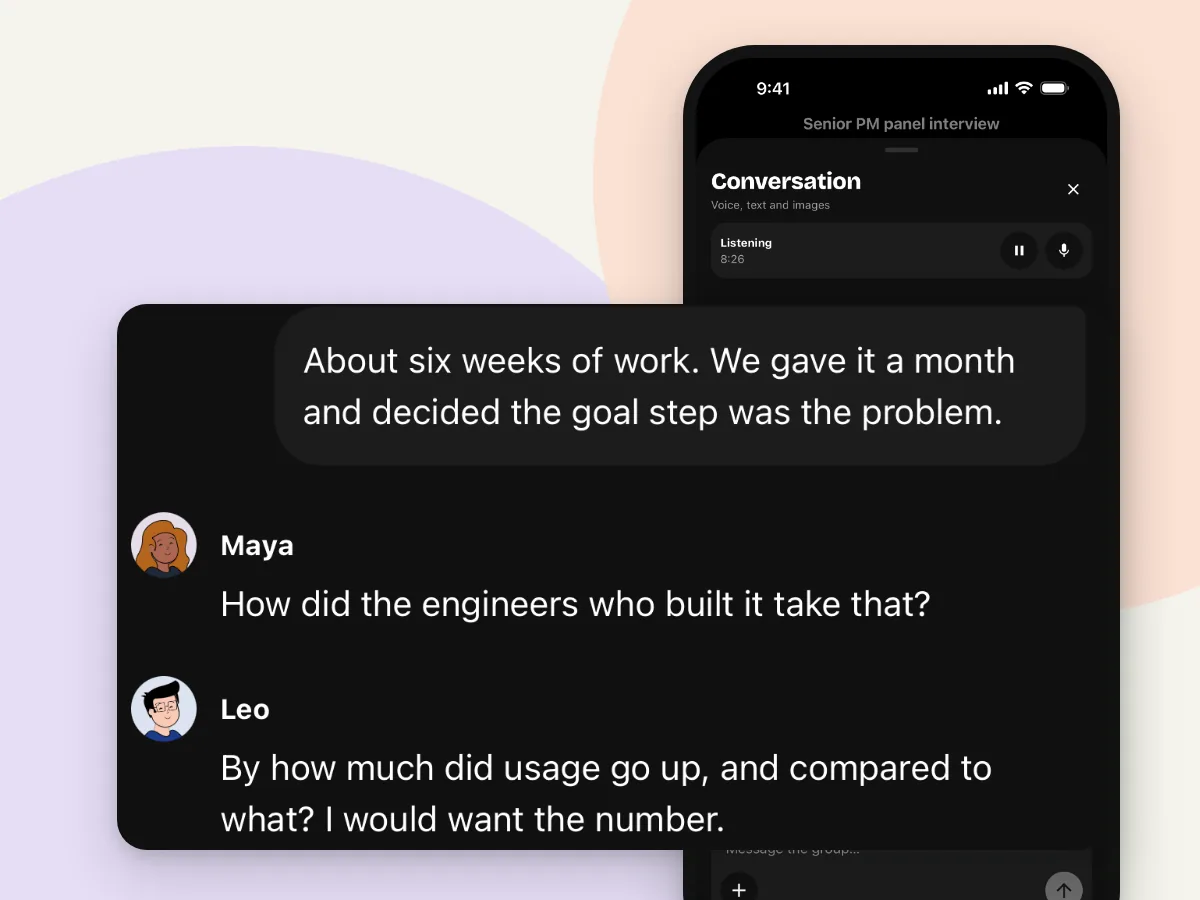
The skeptic caught the vague claim and the hiring manager backed the question up. That is exactly what happens on real panels, and it is far better to find out in practice that you do not have your numbers ready.
Practice formats
- Behavioural round. Ask for "tell me about a time" questions and answer with situation, task, action, result. Ask the panel to interrupt when an answer runs long.
- Technical deep dive. Ask one interviewer to keep digging into a single project until you run out of detail.
- Curveballs. Salary expectations, gaps in your CV, why you are leaving. Better to fumble these in practice.
- Your questions. End every session by asking the panel your own questions and hearing how they land.
- In the interview's language. Calls run in 15 languages, including English, Spanish, Portuguese, French, German, Hindi, Arabic, Japanese and Korean.
If you would rather type an answer that has a lot of detail, open Chat during the call. You can also pause, which stops the clock while you collect your thoughts.
Reviewing the session
Every call is saved in History. Read the transcript with three questions in mind: where did I ramble, where did I give a claim without evidence, and where did a follow-up catch me out? The one-tap summary lists key points and action items, which works well as a prep list for the real interview. To practise again with the same panel, tap Join again and the interviewers come back with the earlier session in front of them.
What it is not
The interviewers are AI voices. They do not know the real company's hiring bar, and they cannot tell you whether you will get the job. Use them to get comfortable answering out loud, under interruption, with several people listening, so that part of the real interview is not new.
Questions
Can I practise interviews in languages other than English?
Yes. Calls run in 15 languages. The cast is written in the language you pick, or in the language your goal was typed in.
How many interviewers can be on the panel?
Between two and eight. Three to five is realistic for most panel interviews. Six join by default, and the app remembers the size you last used.
How much does practice cost?
New accounts get three minutes of call time free, once. After that, monthly plans are $4.99 for 30 minutes, $9.99 for 60, $13.99 for 90 and $17.99 for 120. One minute with the whole room uses one minute, however many voices are in it.
Try it
Three minutes free per new account, no card required. Get it on Google Play or download it on the App Store. Getting ready to pitch instead? Read Practice your pitch with AI investors.