An AI board of advisors you can talk to
Updated: September 27, 2026
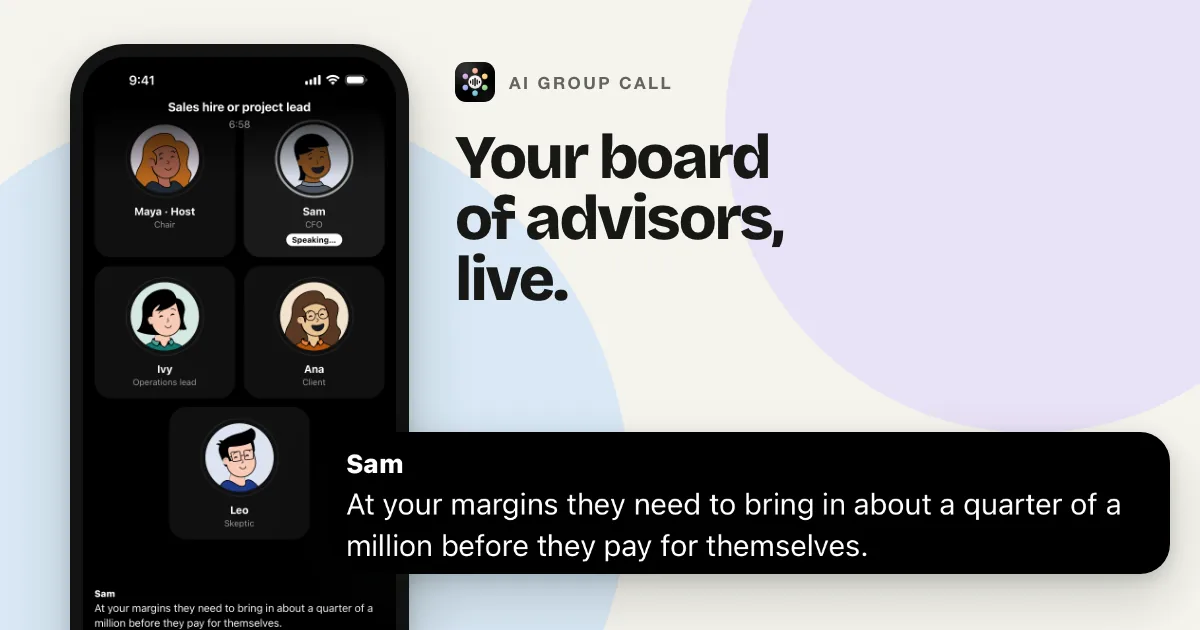
Most founders and solo operators do not have a board. They have one or two people they can call, and a chat assistant that tends to agree with whatever it is told. AI Group Call lets you put a small AI board of advisors on a live voice call: a chair who runs the meeting, a finance voice, an operator, a customer and a skeptic. They hear the whole conversation, answer each other, and push back on you and on each other.
Why a board and not one assistant
A single assistant gives you one blended answer. It weighs the risks and the upside for you and hands back a balanced paragraph, which is often the least useful thing when you are stuck on a decision. A board works differently. Each seat has a job. The finance seat asks what it costs and when the money comes back. The operator asks who does the work on Monday. The customer seat asks why anyone would pay. The skeptic looks for the reason it fails. The useful part is the friction between seats: when the operator says a plan is doable and the finance seat says it is not affordable, you learn exactly where the decision turns.
People search for this as an AI council of advisors or an AI board of directors app. The idea is the same: several named perspectives in one room, instead of one voice trying to be all of them.
Setting up your board
You start a call by typing a goal. The app writes a cast for it: a host who keeps the round moving, plus participants with different roles and viewpoints. In rooms of four or more, the cast is written to include at least one skeptic. To get a board, say so in the goal and name the seats you want. For example:
- "Act as my advisory board. I run a six-person design agency. Seats: a chair, a CFO, an operations lead, a client, and a skeptic. Decision: hire a salesperson or keep selling myself."
Five or six seats is a good size for a board: enough range that a real disagreement shows up, few enough that each seat gets a turn. You pick anywhere from two to eight. If a seat is not pulling its weight, edit that participant's name, role or personality during the call and the rest of the board stays where it is.
You can also fill the seats with different AI models instead. On the Models tab you choose from Claude, GPT, Gemini, Grok, Qwen, DeepSeek and others, and each seat's replies are written by that model. Some people like a board where the disagreement comes from different model makers, not only from different roles. There is more on that on the LLM Council page.
A worked example
Here is a short excerpt of how the salesperson question above might go in a five-seat board.
Example call, written for this page
You We did about forty thousand a month last year and I close every deal myself. I want to know if I should hire a salesperson.
Maya, chair Let's get the numbers first. Sam, you have finance. What would the hire cost against what it needs to bring in?
Sam, finance Salary plus commission, call it seventy to eighty thousand a year all in. At your margins they need to add something like a quarter of a million in new work before they pay for themselves. How long is your typical sales cycle?
You Two to three months.
Leo, skeptic Then you are paying for six months before you know if it works. And the real problem might not be sales. Who delivers the extra work if they land it?
Ivy, operations That is my worry too. The team is already full. I would rather see you hire a project lead first and free up your own time to sell.
Ana, client From the client side, I hired you because I talked to you. A salesperson handing me off to someone else would make me nervous.
Maya, chair So two options on the table: a salesperson, or a project lead so you can keep selling. Leo, what would it take to change your mind on the first one?
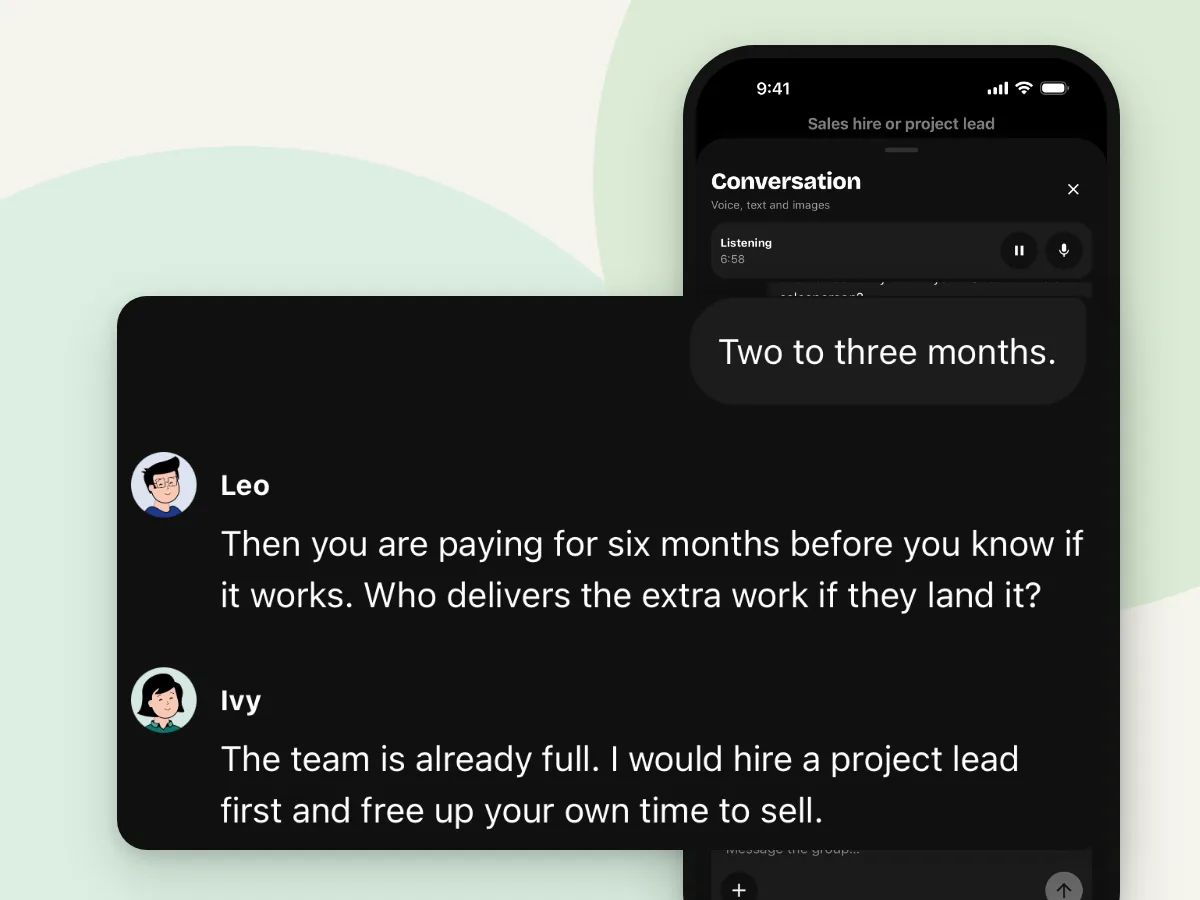
The board found a second option nobody asked about, and made you answer a question (the sales cycle) that changed the maths.
Running a meeting worth the minutes
- State the decision, not the topic. "Should I raise prices by 20% in January" gets a sharper meeting than "pricing".
- Bring your real numbers. Type figures in Chat when they are easier to spell than to say. On any paid plan you can share up to three screenshots or photos per message, so a revenue chart or a price sheet can go straight to the board.
- Ask for a vote. Near the end, ask each seat for a yes or no and one reason. It forces the board to commit.
- Interrupt. Start talking and whoever is speaking stops. You do not have to wait your turn.
- Pause to think. Pausing the call pauses your minutes too.
After the meeting
Every call is saved in History with the full transcript. Tap once for a summary with key points and action items, and share the summary and transcript to email, notes or a co-founder from the share button. For a board you meet regularly, Join again brings back the same seats with the earlier conversation in front of them, so next month's meeting can start with "here is what happened since". Participants in later calls are also told a few things earlier casts learned about you. You can clear that memory in Settings.
What an AI board is not
It is not a legal board, it has no duty to you, and it only knows your business through what you tell it. Treat it as a way to hear objections early and find the questions you have not asked yourself. Check any figure a participant quotes before you rely on it, and take legal, tax or financial decisions to a qualified person.
Questions
Can I choose who sits on the board?
Yes. Name the seats in the goal you type and the cast is written around them. During the call you can edit any participant's name, role or personality. Or pick AI models for the seats on the Models tab.
Can I meet the same board again?
Yes. Open the call in History and tap Join again. The same cast comes back with the earlier conversation in front of them.
How much does it cost?
New accounts get three minutes of call time free, once. After that, monthly plans are $4.99 for 30 minutes, $9.99 for 60, $13.99 for 90 and $17.99 for 120. One minute with the whole room uses one minute, however many voices are in it.
Try it
Three minutes free per new account, no card required. Get it on Google Play or download it on the App Store. If you mainly want to test a plan before you commit to it, read Roast my business idea.