Roast my business idea: a room of AI critics, live
Updated: September 27, 2026
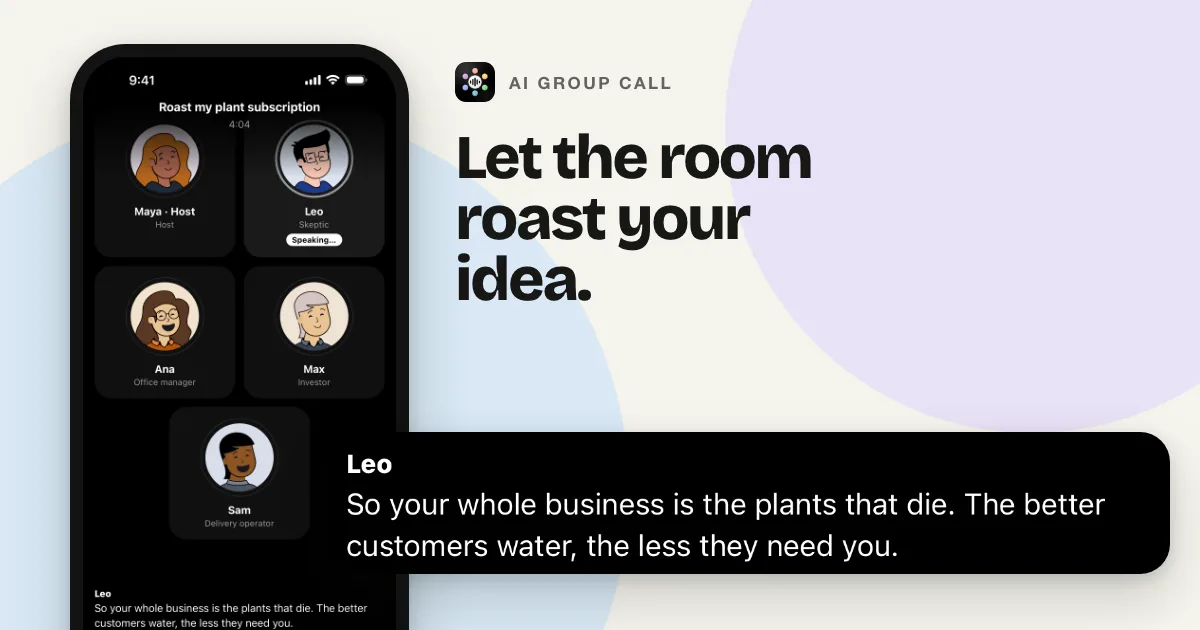
Friends are polite about your idea. A chat assistant is usually encouraging. Neither tells you the thing that will actually sink it. AI Group Call lets you put your business idea in front of a room of AI critics on a live voice call: a skeptic, a customer, an investor, an operator. You ask them to roast it, and they do, out loud, building on each other's objections.
Why a roast beats a pep talk
The expensive way to find a flaw in a business idea is to build it first. The cheap way is to hear every objection before you start. A roast is a quick way to collect those objections. Because the critics hear each other, one person's worry often sets off a sharper one: the customer says they would not switch, the investor asks what that means for acquisition cost, and the operator asks how you would deliver it anyway.
This is also one of the most common reasons people use AI Group Call: pressure-testing a pitch or a business idea before putting time or money into it.
Setting up the roast
Type a goal that describes the idea and asks for bluntness. The app writes a cast around it. In rooms of four or more, at least one participant is written as a skeptic, and a host keeps the roast from turning into noise. For example:
- "Roast my startup idea: a subscription that sends office plants and swaps them when they die. Be brutal. I want a skeptic, an office manager who would buy it, an investor and someone who has run a delivery business."
- "Roast my plan to open a board-game café in a small town. Tell me why it fails."
Four to six critics is a good size. With two you get a debate; with eight you get the widest spread of angles. Whatever you pick, one minute of call time costs one minute.
A worked example
An excerpt from the office plant subscription roast.
Example call, written for this page
You Offices pay a monthly fee, we deliver plants, and if one dies we replace it for free.
Leo, skeptic So your whole business is the plants that die. The better your customers are at watering, the less they need you. The worse they are, the more it costs you.
Ana, office manager Honestly, I would pay for this, but it is the first thing I cut when the budget gets tight. What makes it not optional?
Max, investor And what stops a local florist doing the same thing tomorrow? Where is the moat?
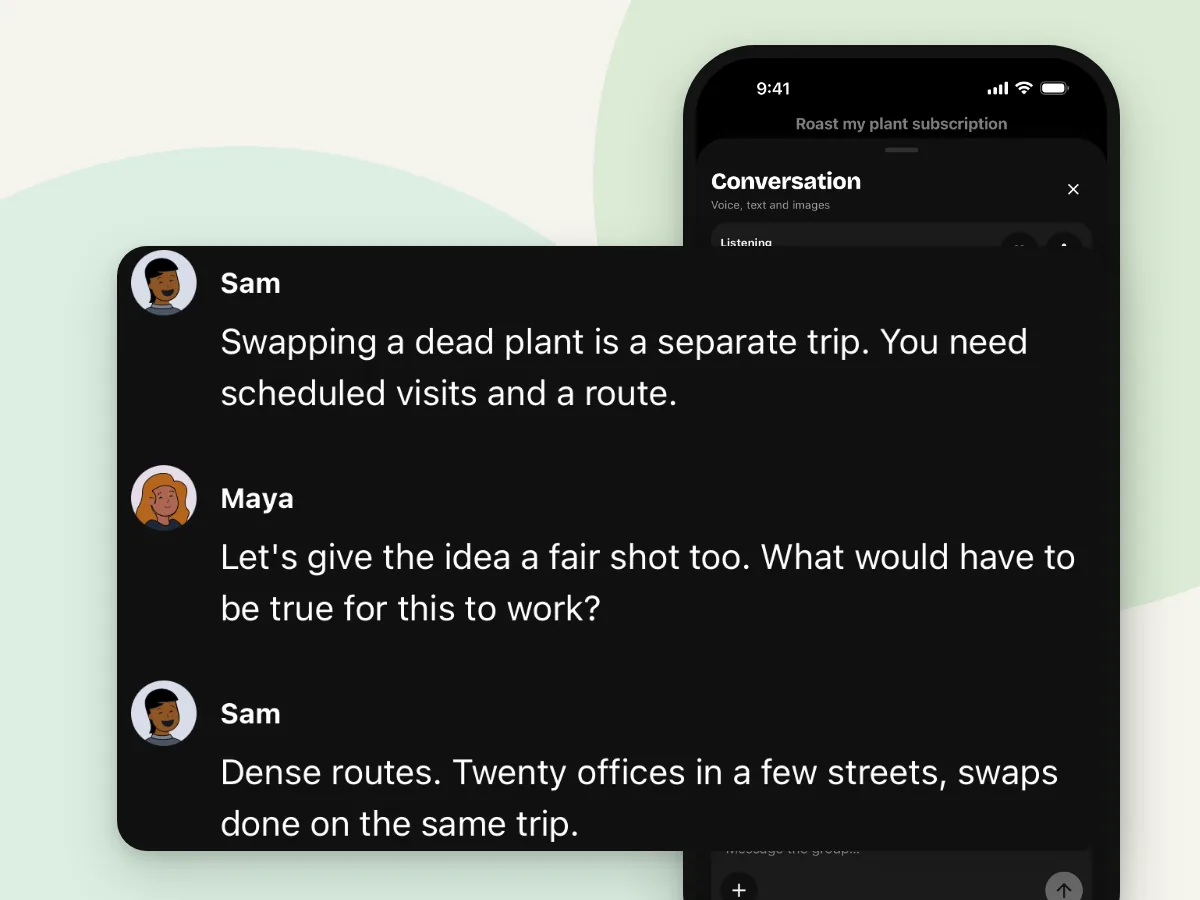
Sam, delivery operator I have run vans. Swapping a dead plant is a separate trip. If you are doing one visit per swap, the maths gets ugly fast. You need scheduled visits and a route.
Maya, host Let's give the idea a fair shot too. What would have to be true for this to work?
Sam, delivery operator Dense routes. Twenty offices in a few streets, a fixed monthly visit, swaps done on the same trip.
In a few minutes the idea went from "plant subscription" to a specific question worth testing: can you sign up enough offices in a small area to make one route pay? That is the kind of result a good roast gives you.
Objections to expect
Every idea is different, but these questions come up again and again, and it is worth having an answer ready for each:
- Who pays, and why now? Not who would like it, but who would pay this month.
- How do customers find you? "Social media" is not an answer the room will accept.
- What does one customer cost you? Delivery, support, refunds, time.
- Who else does this? Including the option of doing nothing.
- Why you? What you know or have that someone else starting tomorrow does not.
How to take a roast
- Do not defend every point. Let a round finish. The second and third replies often go deeper than the first.
- Ask what would change their mind. It turns an objection into a test you can run.
- Ask for the fair case too. Once the flaws are out, ask the room to argue for the idea. You need both.
- Show them. On any paid plan, share up to three screenshots or photos per message: a landing page, a price list, a mock-up.
- Interrupt. Start talking and whoever is speaking stops.
After the roast
Open the call in History and tap once for a summary with key points and action items. Treat the action items as experiments: things to check before you build. Share the summary and transcript with a co-founder from the app. When you have run the tests, tap Join again and the same critics come back with the earlier roast in front of them, so you can tell them what you found and see if they still hold their objections.
What a roast cannot do
AI critics can find gaps in your reasoning, but they do not know your local market, and they cannot tell you whether customers will pay. Only customers can. If a participant quotes a figure, check it. Use the roast to decide what to test first.
Questions
Will the AI critics actually be harsh?
Ask for it in your goal, for example "be brutal" or "tell me why it fails". In rooms of four or more, the cast always includes at least one skeptic, and you can edit any participant's role or personality during the call to make them tougher.
Can I roast the same idea again after I change it?
Yes. Tap Join again on the saved call. The same cast returns with the earlier conversation in front of them.
How much does it cost?
New accounts get three minutes of call time free, once. After that, monthly plans are $4.99 for 30 minutes, $9.99 for 60, $13.99 for 90 and $17.99 for 120. One minute with the whole room uses one minute, however many voices are in it.
Try it
Three minutes free per new account, no card required. Get it on Google Play or download it on the App Store. Want steady advice on the business once it is running? Read An AI board of advisors you can talk to.