A panel of experts you can actually talk to
Updated: October 5, 2026
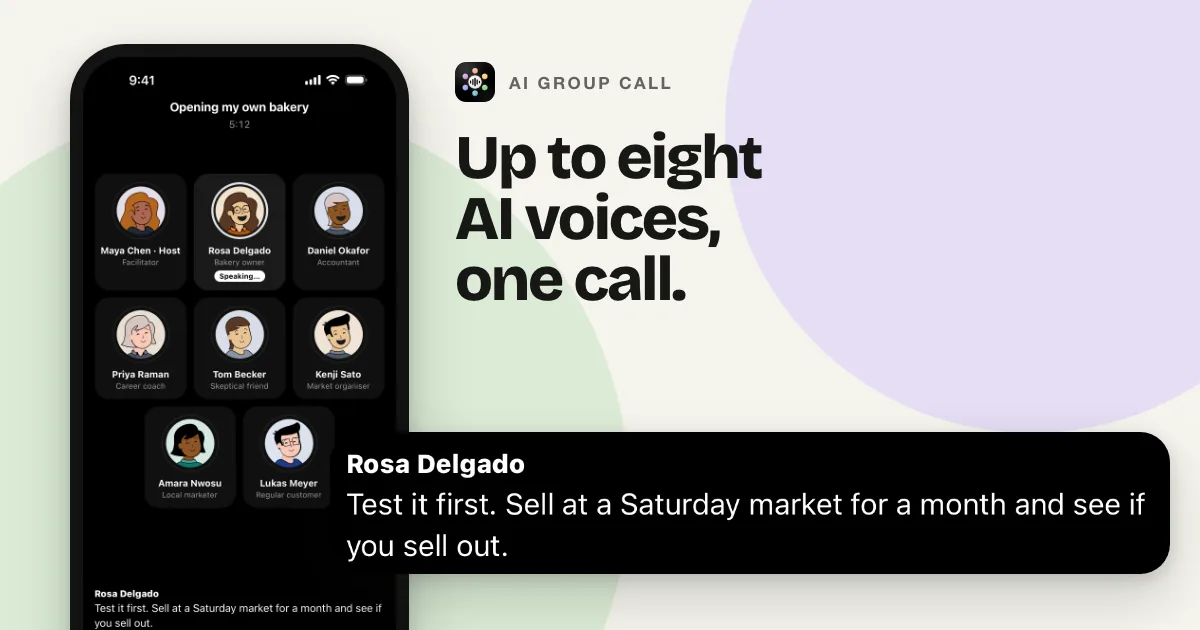
When you want several expert views on one question, today you get a search box: ten articles, a podcast playlist, a Reddit thread. Each source speaks once, at you, and none of them have read each other. AI Group Call gives you the other version: a panel of experts that is a live voice call. You say what you want to decide, a panel forms around it — a host, a domain expert, a skeptic, other viewpoints — and they talk it through out loud, with you in the room.
What an AI panel of experts is
You type a goal, the same way you would brief a moderator: "Weigh whether to move our agency's hosting to a usage-billed platform." The app writes a cast for that question: a host who runs the round, participants with different roles and viewpoints, and in rooms of four or more at least one skeptic or devil's advocate. Everyone hears the whole conversation before their turn, so a second voice pushes back on the first one's answer while you are still hearing it. When two seats disagree, you can ask each one why. When the room drifts, you say so, and it stops and follows your new thread.
You can shape the panel before it opens. Name the seats you want in your goal — "Seats: a cloud architect, a CFO, a security reviewer, and a skeptic" — and the cast is written around them. Or skip the roles and fill the seats with AI models instead: on the Models tab you pick from Claude, GPT, Gemini, Grok, Qwen, DeepSeek and others, one model per seat, and each seat's replies are written by that model and spoken aloud. During the call you can edit any participant's name, role or personality and the rest of the panel stays where it is.
A worked example
A studio founder asks a four-seat panel whether to re-sign a client at half the old rate.
Example call, written for this page
You Our biggest client wants to renew at half last year's rate. It's forty percent of our revenue. Do we take it?
Priya, host Let's frame it: this is a concentration question as much as a price question. Dana, you're finance. What does half rate do to us?
Dana, finance On paper it's survivable if nothing else moves. But you'd be trading your best negotiating position for it now, six months before renewal, and you'd have to make it back somewhere.
Marcus, sales I'd take it, briefly. A renewing logo at half rate still buys you twelve months to replace forty percent of revenue without a public churn story.
Sam, skeptic And it's a hostage deal. They cut to half because they can. Sign it and next year they offer a third. What happens if you say no?
You We lose the revenue within a quarter. Honestly, I don't know of another client that size.
Priya, host Then the real agenda is the pipeline, not the rate. Counter-proposal: eighteen months at two-thirds, with a quarterly pipeline commitment from you. Sam, does that change your read?
Sam, skeptic It's a better answer than signing at half. I'd still ask them why the cut, because if their budget shrank there's a second cut coming.
Four starting positions, one reframe, and a counter-offer the room converges on — with the skeptic still on the record about the second cut. That conversation is the product. When you hang up, the call generates a summary with key points and action items, and the saved transcript shows which seat said what, so you can rejoin the same panel later and pick it up.
What people bring to the panel
- A decision with no obvious right answer. Hire or not, sign or walk, ship or wait. The panel's value is the disagreement, and you referee it.
- A pitch or proposal that needs beating up first. Present it to the room and take the questions before a real audience does. There is a dedicated version of this on the pitch practice page.
- A topic you are new to. Ask for a panel that explains from different angles — and keeps the jargon honest, because you can interrupt any seat and ask "what does that actually mean?"
- A question one assistant keeps hedging. A single assistant blends its answer into one careful paragraph. Separate seats commit, defend, and change their minds in front of you.
For the model-seat version of the panel — Claude, GPT, Gemini and Grok arguing in the same call — read LLM Council, by voice. For a standing panel around a business decision, see the AI board of advisors.
Questions
Are the panel experts real people?
No, and this is the one thing to understand before you download it. Every seat is an AI participant: a generated persona with a role and personality, or a named AI model you pick for that seat. The panel gives you several distinct, disagreeing perspectives in one live conversation, not credentials. Treat it the way you would treat a smart, adversarial discussion with informed strangers: genuinely useful for framing a decision, not a substitute for a lawyer, a doctor, or an auditor. Check anything load-bearing.
How many experts can be on the panel?
Two to eight AI participants per call, six by default, plus you. Five or six is a good panel size: enough range for a real disagreement, few enough that each seat gets a turn.
Can I pick which expert speaks?
Yes. Name a participant in the call and they answer you. A director picks who speaks in the general back and forth, and the person you name goes first.
What happens when the panel ends?
The call generates a summary with key points and action items, and the transcript is saved showing which seat said what. You can rejoin the same panel later and continue the conversation.
Does it work in my language?
Calls run in 15 languages. The cast — roles, names, personalities — is written in the language you pick, or in the language you type your goal in.
Try it
Three minutes free per new account, no card required. Get it on Google Play or download it on the App Store. For the broader story on one call with many AI voices, read Talk to multiple AIs at once.